
Stacking Disruption Vectors

A lot has been said about whether it’s a great team or market that makes a successful venture investment. It’s not uncommon to hear VCs say things like “I love the team, but I just hate the market”. Many investors even go so far as to describe themselves as either “founder-driven”, or “market-driven”.
One of my favourite quotes that encapsulates this mentality comes from Benchmark cofounder, Andy Rachleff.
"When a great team meets a lousy market, market wins. When a lousy team meets a great market, market wins. When a great team meets a great market, something special happens."
He’s effectively saying market forces are more powerful than a team.
I like to think about this team and market question as stacking disruption vectors. As you’ll remember from high school physics, a vector is a quantity having both magnitude and direction.
Why disruption? The outlier startups are all disruptive at their core. I think it would be difficult to name a single consequential startup founded in the last 20 years that hasn’t been disruptive.
What vectors do you need? This is relatively obvious – it’s team, market and product. I think of this as:
Team: Does this team spike on one (or more) critical dimensions that allow them to have a non-zero chance of disrupting or creating an entire industry?
Market: Is this a large opportunity with market forces at play that will allow this company to play the game on easy mode? I’ve written more about this here.
Product: Does this combination of team and market allow for the creation of a disruptive product?
The descriptions of these vectors all have to do with magnitude.
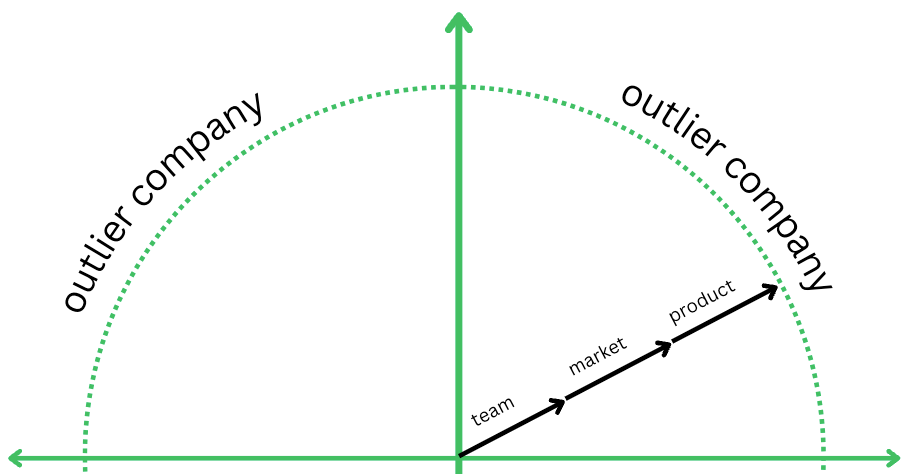
Are the vectors stacked?
The final element has to do with the direction of the vectors. Outlier outcomes require the vectors to point in the same direction. If they don’t, the vectors will cancel each other out, or lead to no man’s land. Over time, the vectors should continue stacking on each other and bring you closer and closer to the edge.
In the context of hiring, you want to hire people who are not only highly skilled (magnitude) but are also aligned with the goals and values of the company (direction). Over time, you want to stack more and more vectors such that you have a directionally aligned team, that creates a world-class product that either disrupts or creates a market. I think of this as a self-propagating wave of vectors. Directionally aligned vectors are often one of the key advantages a startup has over incumbents, who traditionally have hundreds of slightly misaligned team vectors, all working with a market vector that is difficult to shift, thus leading to a stagnant or mispointed product vector.
As always, I’d love any thoughts or feedback.